Book a discovery call
Playground

Play with the data.

The B4A Data & AI Playground turns official data on migration, education, trade, AI and work into stories you can read, watch and check. Every number shows its source and its period.

Latest stories
Official data, original analysis

Six stories. One method.

Visa Odds No. 0374.5%
People & Places
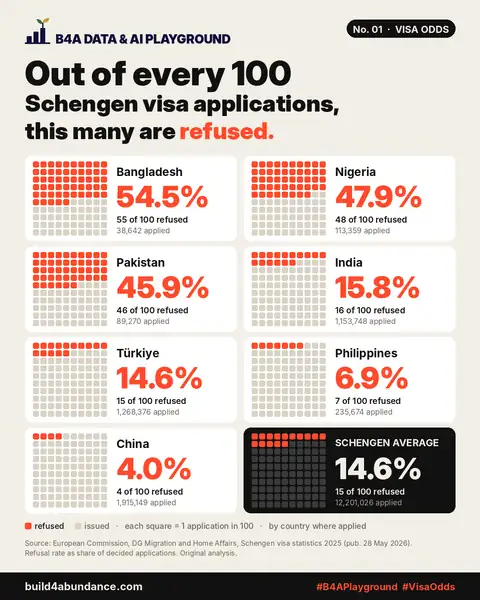
One consulate, half the refusals.

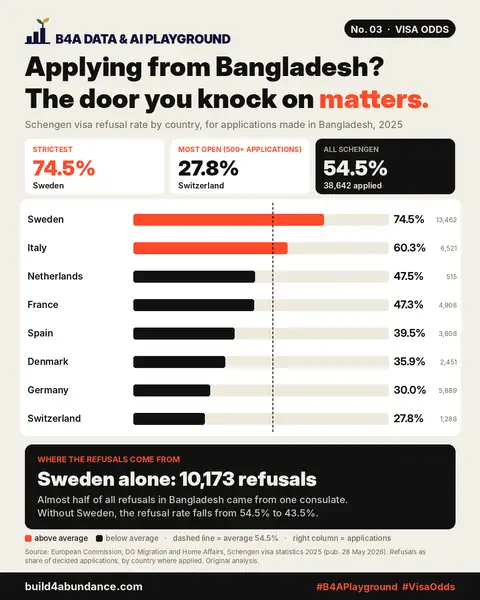
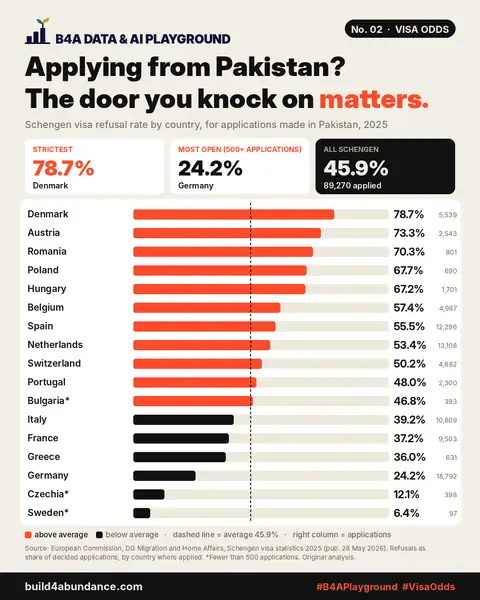
In 2025, Schengen consulates in Bangladesh refused 20,918 applications. Sweden, the busiest door in Dhaka, refused 74.5%. Without Sweden, the refusal rate for Bangladesh falls from 54.5% to 43.5%.

Source: European Commission, 2025 Schengen visa statistics. B4A analysis.

See the data and source
B4A Visa Odds No. 01 cardB4A Visa Odds No. 02 cardB4A Visa Odds No. 03 cardB4A Visa Odds No. 04 cardB4A Visa Odds No. 05 card
  • Bangladesh, 2025: 20,918 Schengen applications refused.
  • Sweden, the busiest door in Dhaka, refused 74.5% of the applications it handled.
  • Without Sweden, the Bangladesh refusal rate falls from 54.5% to 43.5%. That second figure is a B4A calculation.
European Commission, Schengen visa statistics →Read the full data story →Refusal rates by country of application →
Higher Ed No. 01-17%
People & Places

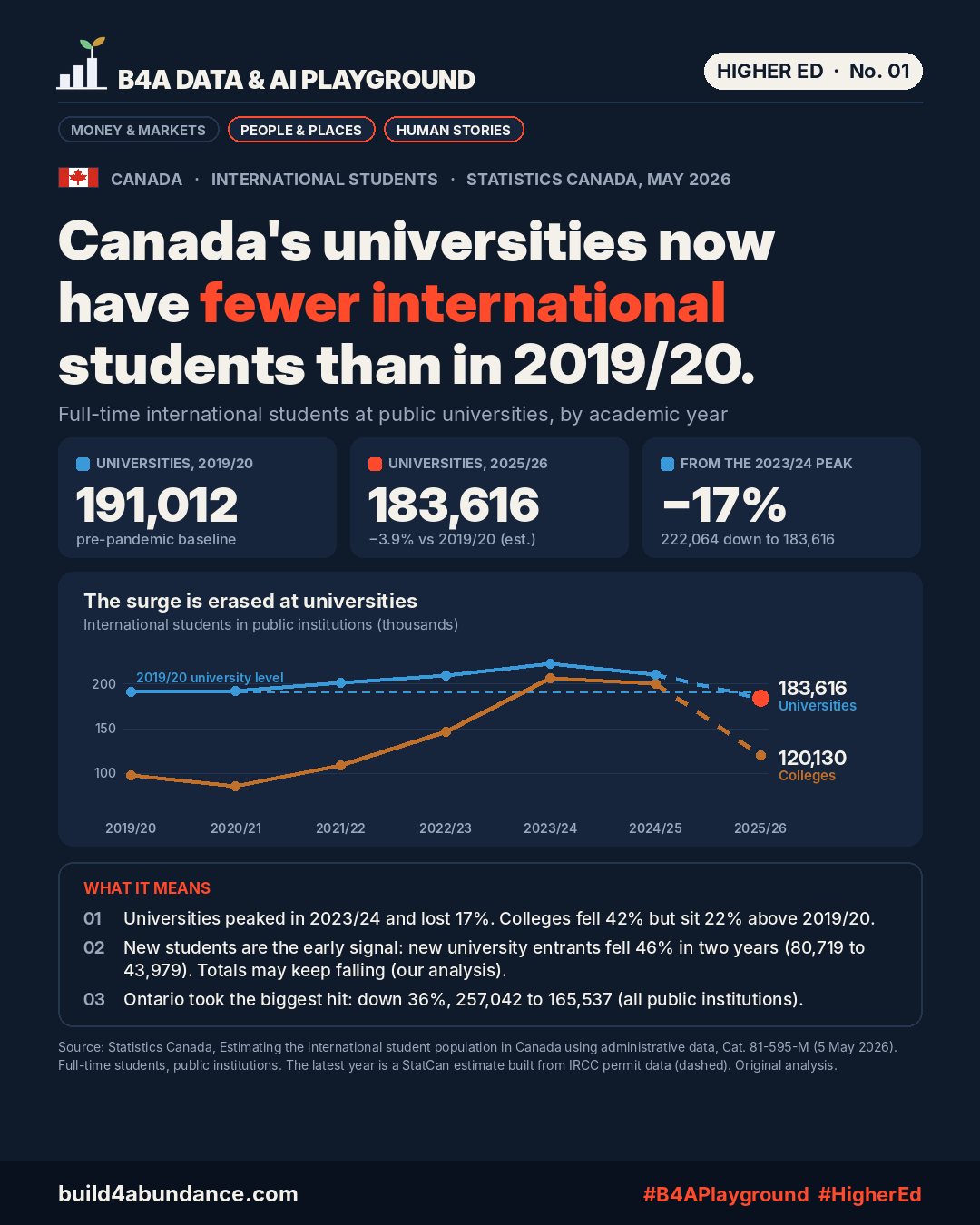
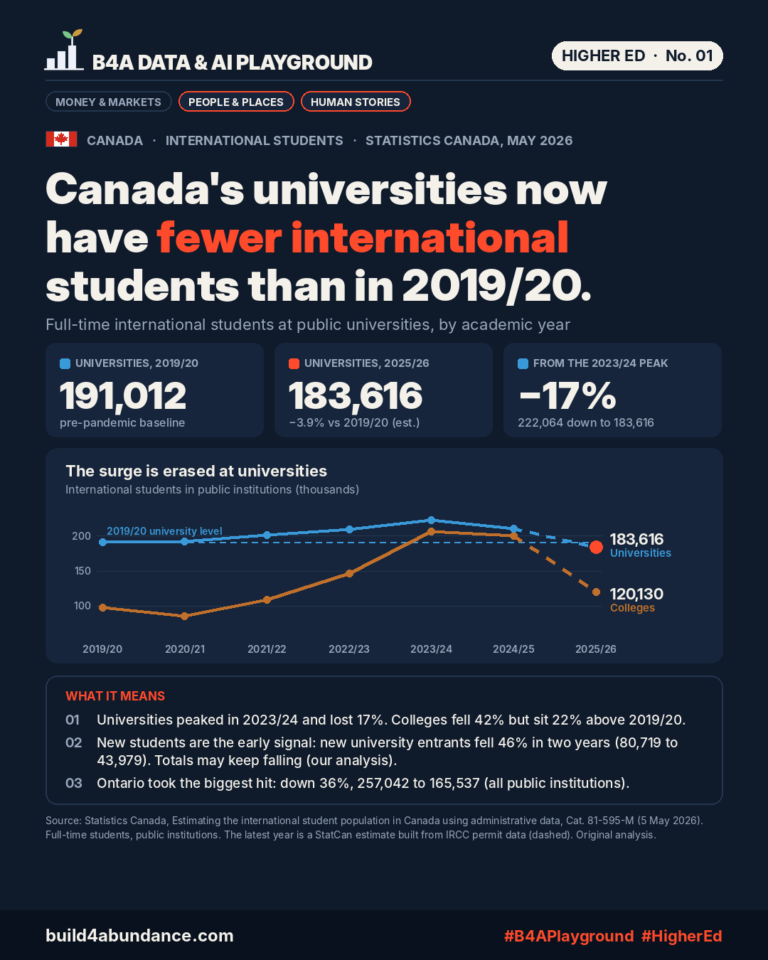
Canadian universities have fewer international students than before the pandemic.

Full-time international students at public universities: 183,616 in 2025/26, against 191,012 in 2019/20 and a peak of 222,064 in 2023/24.

Source: Statistics Canada, estimates published 5 May 2026. The 17% is the fall from the 2023/24 peak (B4A calculation).

See the data and source
Higher Ed No. 01 data cardHigher Ed No. 02 data cardHigher Ed No. 03 data card
  • Full-time international students at public universities: 183,616 in 2025/26, 191,012 in 2019/20, a peak of 222,064 in 2023/24.
  • The 17% fall is measured from the 2023/24 peak (B4A calculation).
  • These are estimates from an administrative-data feasibility study, so treat them as estimates.
Statistics Canada, The Daily, 5 May 2026 →
AI Economy No. 0112.6 pts
Money & Markets

The AI gap is widening.

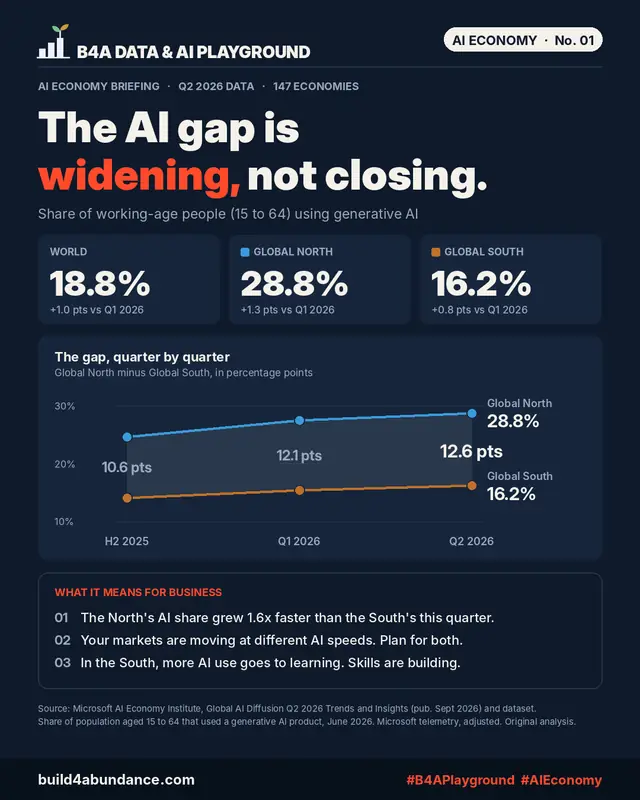
Generative AI use among working-age people is 28.8% in the Global North and 16.2% in the Global South, a gap of 12.6 points. It was 10.6 points at the end of 2025.

Source: Microsoft AI Economy Institute, Global AI Diffusion, Q2 2026. Independent analysis, not affiliated with Microsoft.

See the data and source
AI Economy No. 01: The AI gap is widening, not closing. Global North 28.8%, Global South 16.2%, gap 12.6 points.
  • Generative AI use among working-age people: 28.8% in the Global North, 16.2% in the Global South, 18.8% worldwide.
  • The North and South gap is 12.6 points, up from 10.6 points at the end of 2025.
  • Period: Q2 2026 report, June 2026 data. Microsoft publishes the estimates; this is independent analysis.
Microsoft, The continued state of global AI diffusion in 2026 →
AI Economy No. 023.9%
Money & Markets

Chips surge, holidays barely move.

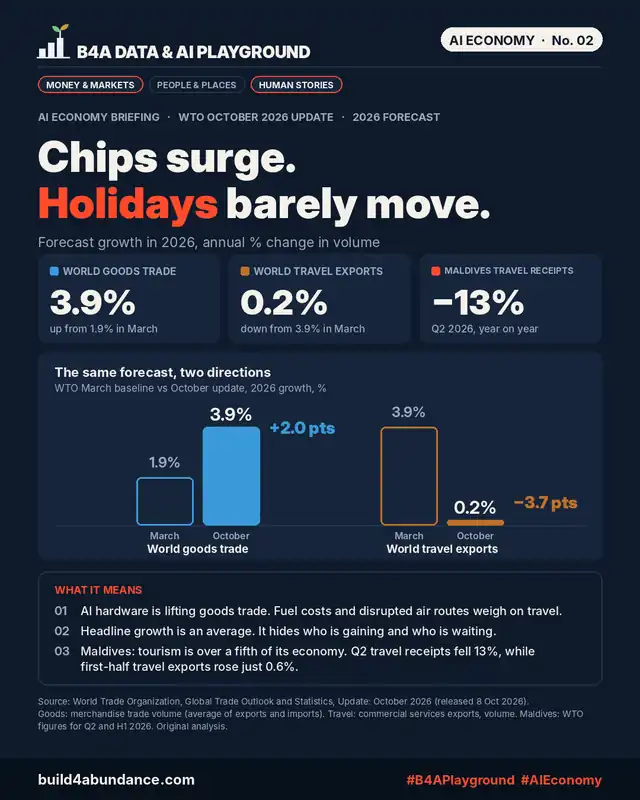
The WTO raised its 2026 forecast for world goods trade growth to 3.9%, from 1.9% in March, on demand for AI hardware. Over the same months its forecast for travel exports fell from 3.9% to 0.2%.

Source: World Trade Organization, Global Trade Outlook and Statistics, October 2026 update.

See the data and source
AI Economy No. 02: Chips surge, holidays barely move (WTO October 2026 update).
  • 2026 forecast for world goods trade growth: 3.9%, up from 1.9% in March, on demand for AI hardware.
  • 2026 forecast for travel exports: 0.2%, down from 3.9% over the same months.
  • Period: WTO update of 8 October 2026.
WTO, Global Trade Outlook and Statistics update, October 2026 →
Future of Work No. 01200+
People & Places

A top AI lab stops asking for the PhD.

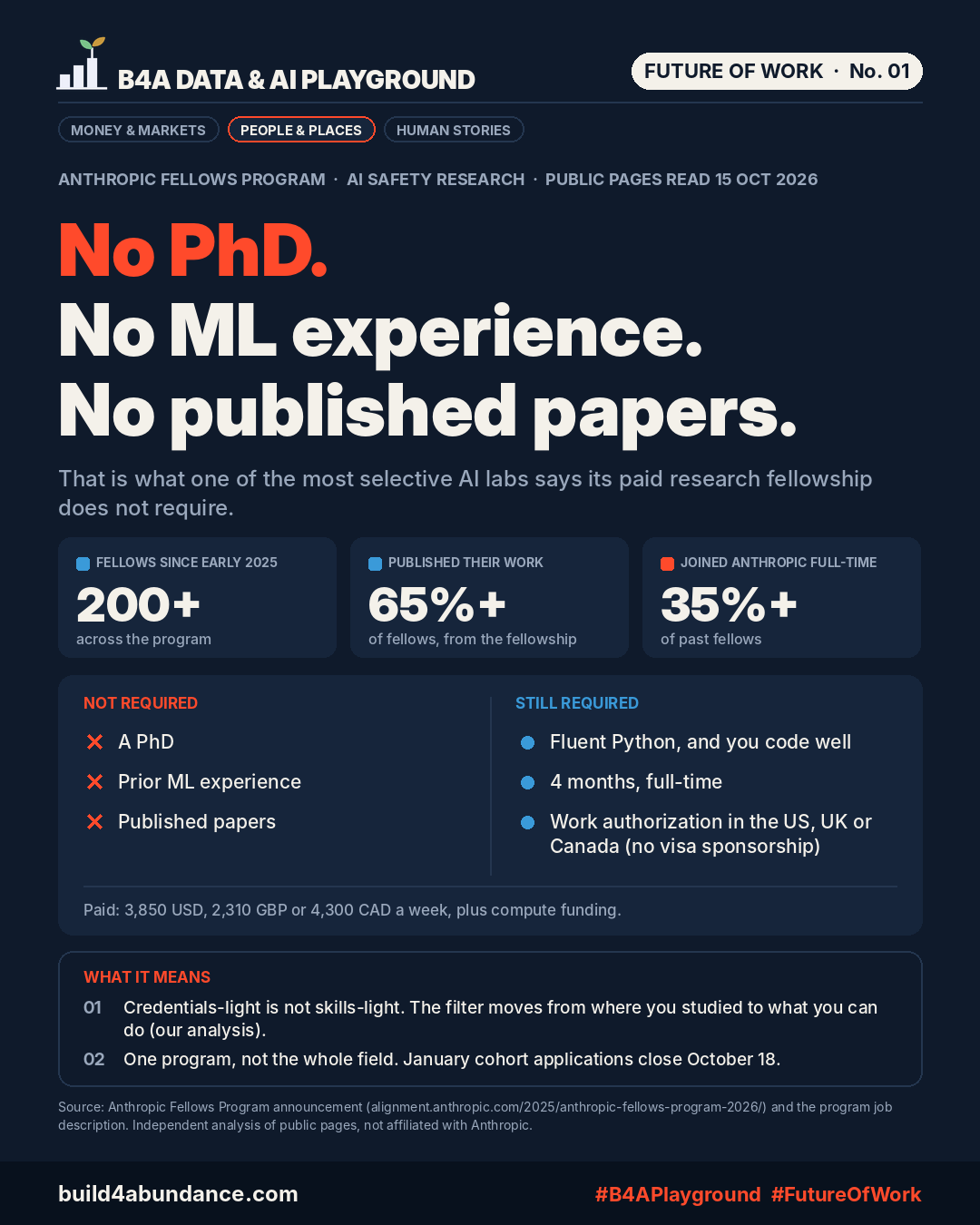
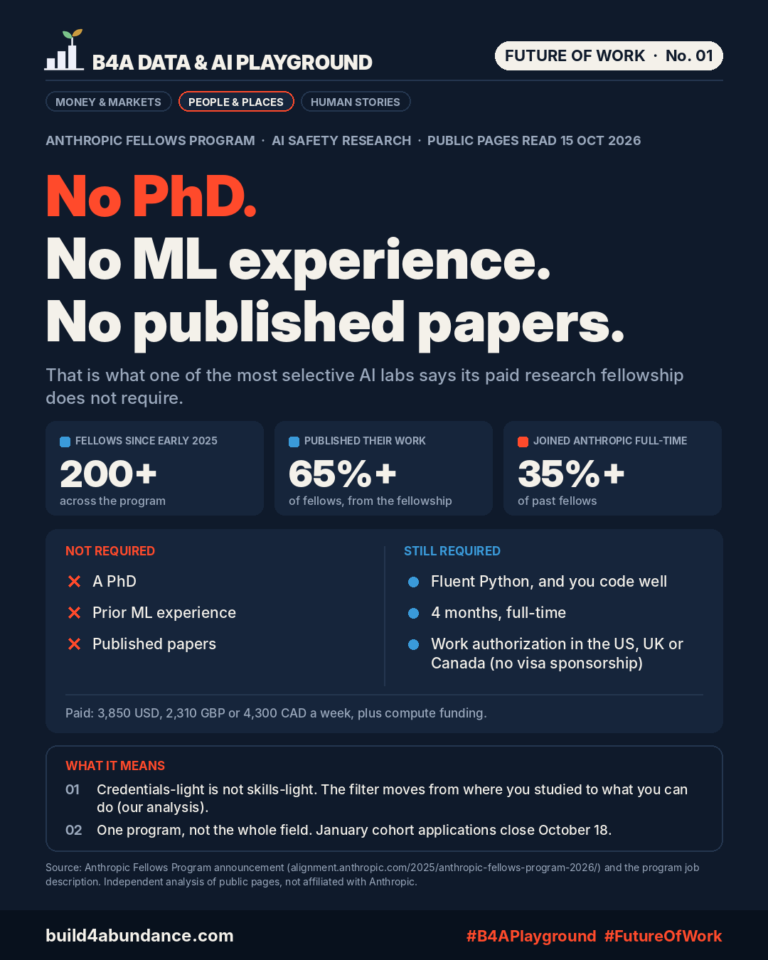
More than 200 fellows since early 2025. Over 65% published work from the fellowship and over 35% joined Anthropic full-time. This is one program, not the whole field, and the bar is still real.

Source: Anthropic Fellows Program page (alignment.anthropic.com). Independent analysis, not affiliated with Anthropic.

See the data and source
  • More than 200 fellows have taken part since early 2025.
  • Over 65% published work from their fellowship. Over 35% of past-cohort fellows joined Anthropic full-time.
  • The program page says you do not need a PhD, prior ML experience or published papers. It is one program, not the whole field.
Anthropic Fellows Program page →
B4A Studio sample417k
Studio

One housing report, many formats.

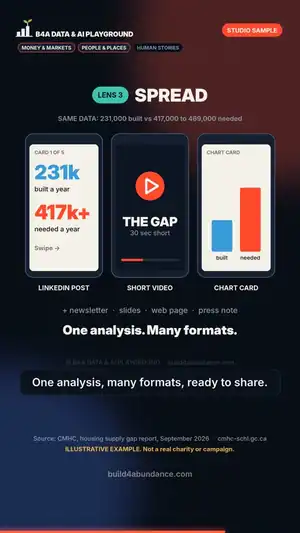
Canada builds 231,000 homes a year. CMHC estimates 417,000 a year are needed to restore 2019 affordability by 2036. The same numbers become a donor appeal, a short video and a chart card.

Source: CMHC, housing supply gap report, September 2026. Independent analysis, not affiliated with CMHC. The charity and appeal in the sample are illustrative.

See the data and source
  • CMHC says housing starts need to reach 417,000 to 469,000 a year to restore affordability to pre-pandemic levels by 2036.
  • The sample turns one report into a donor appeal, a short video and a chart card.
  • The charity and appeal in the sample are illustrative, not a real campaign.
CMHC, Housing Supply Report, 10 September 2026 →
Data cards
One card per story, with the source on every card

The numbers, one card each.

Higher Ed No. 01 data card: Canada's universities have 183,616 international students in 2025/26, against 191,012 in 2019/20 and a peak of 222,064 in 2023/24. Source: Statistics Canada.
Higher Ed No. 01

Canada’s universities now have fewer international students than in 2019/20. Source: Statistics Canada, 5 May 2026.

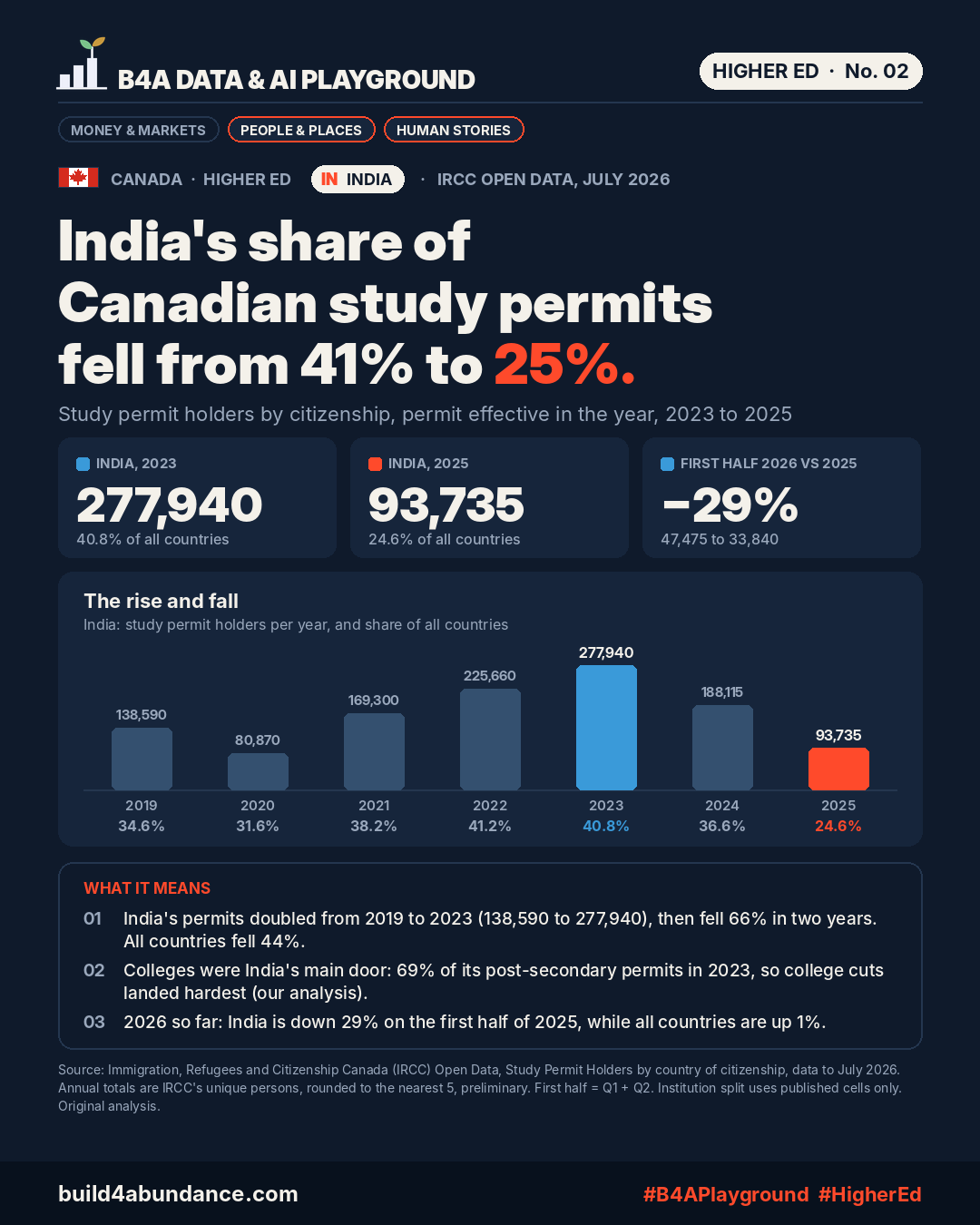
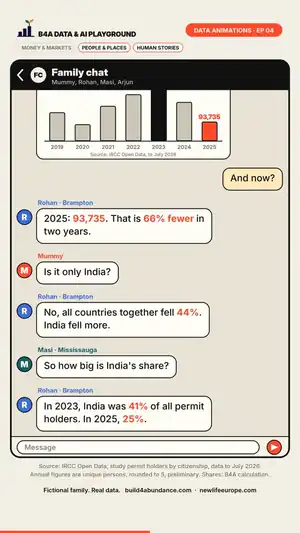
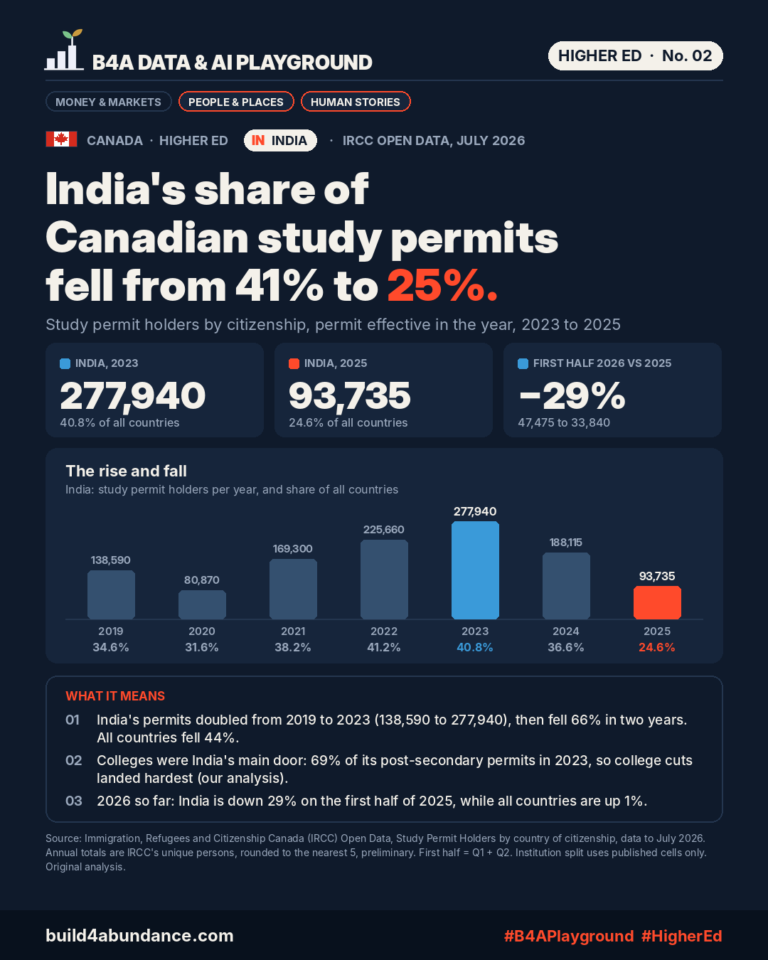
Higher Ed No. 02 data card: India's share of Canadian study permits fell from 41% to 25% between 2023 and 2025. Source: IRCC Open Data.
Higher Ed No. 02

India’s share of Canadian study permits fell from 41% to 25%. Source: IRCC Open Data, data to July 2026.

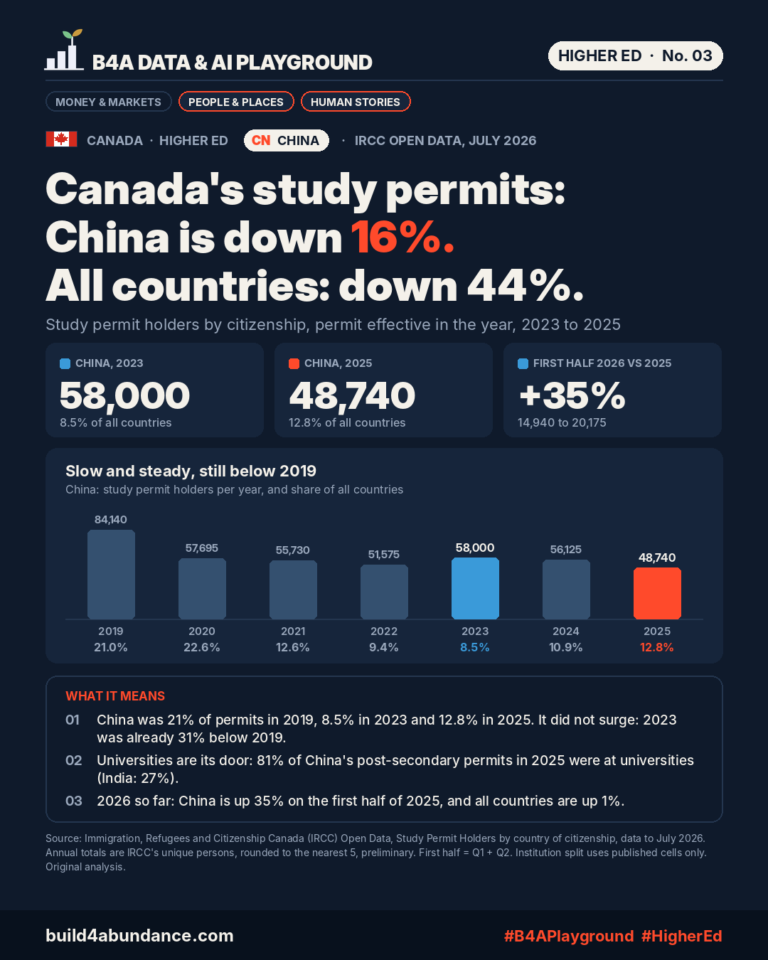
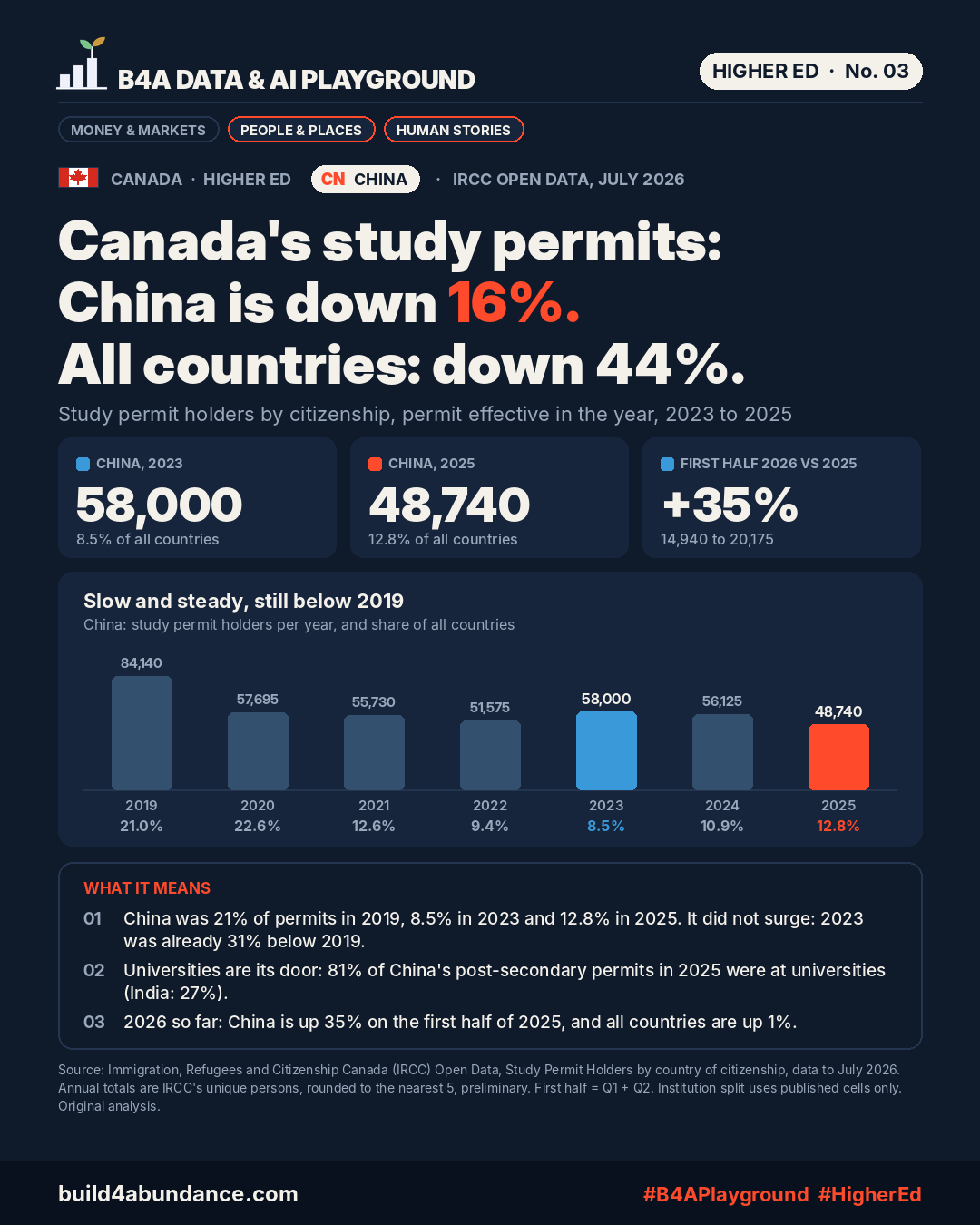
Higher Ed No. 03 data card: study permits for China are down 16% since 2023, while all countries are down 44%. Source: IRCC Open Data.
Higher Ed No. 03

China is down 16% since 2023. All countries are down 44%. Source: IRCC Open Data, data to July 2026.

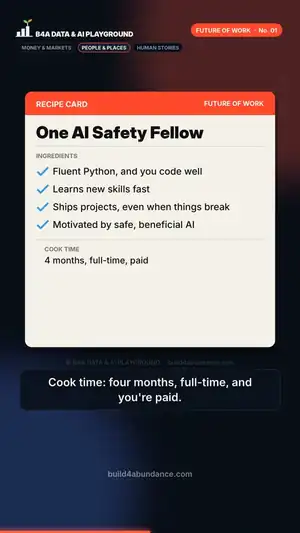
Future of Work No. 01 data card: Anthropic's paid AI research fellowship says it needs no PhD, no machine learning experience and no published papers. Over 200 fellows since early 2025.
Future of Work No. 01

No PhD, no ML experience, no published papers. Source: Anthropic Fellows Program announcement. Independent analysis, not affiliated with Anthropic.

Numbers as characters.

Short videos where the data is real. Where a story has people in it, they are invented and labelled fictional on screen.

See all our work: videos, cards, reports and demos

Data Animations Ep 03 · Human Stories

The Address Change

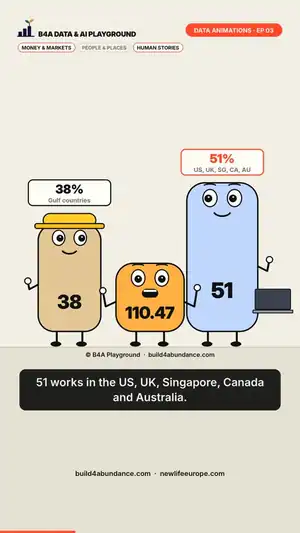
Where India’s remittances come from: $110.47 billion in total. In 2023-24 the Gulf countries sent 38% and the US, UK, Singapore, Canada and Australia together sent 51%.

Fictional story, real data. Sources: Reserve Bank of India, balance of payments FY2025-26 and Remittances Survey 2023-24 (RBI Bulletin, March 2025). Group totals are a B4A calculation.

Data Animations Ep 04 · People & Places

Is Canada still okay, beta?

A family group chat about study permits. People from India held 277,940 Canadian study permits in 2023 and 93,735 in 2025, down 66%. India’s share fell from 41% to 25%. In the first half of 2026 India is down 29% on a year earlier, while all countries are up 1%.

Fictional family chat, real data. Source: Immigration, Refugees and Citizenship Canada (IRCC) Open Data, study permit holders by citizenship, data to July 2026. Shares are a B4A calculation.

Future of Work No. 01 · People & Places

Check the pantry.

What it takes to join Anthropic’s paid AI safety fellowship: fluent Python, fast learning, projects shipped and motivation to make AI safe. No PhD or published papers needed. Four months, full-time, paid.

An independent, creative take on Anthropic’s public Fellows Program announcement. Not affiliated with or endorsed by Anthropic. The recipe card is illustrative. Created with AI assistance.

B4A Studio sample

One housing report, many formats.

A sample of what Studio makes from one report: a donor appeal, a short video, a LinkedIn post and a chart card from the same numbers. The data: 231,000 homes built a year against 417,000 needed. See Studio

Source: CMHC, housing supply gap report, September 2026. Independent analysis, not affiliated with CMHC. The charity and appeal are illustrative, not real. Created with AI assistance.

The series
Each series has its own numbering and its own sources

Where the data comes from.

  • Visa OddsSchengen visa outcomes, country by country. Source: European Commission. Live
  • AI EconomyWho gains from AI and who waits. Sources: Microsoft AI Economy Institute, World Trade Organization. Live
  • Future of WorkCareers and skills in the AI era. Source: Anthropic Fellows Program page. OECD Skills for Jobs 2026 is next. Live
  • Per Person IndexBig numbers shared out per person. First issue: your share of Nvidia. Sources: Nasdaq price data, Nvidia 10-Q, UN World Population (B4A calculation). Live
  • Data AnimationsNumbers and people as characters in short videos. Sources named in each video. Live
  • Data ShortsSixty-second visual explainers. Sources: European Commission, UK Home Office. Live
  • Higher EdInternational students in Canada, and where they come from. Sources: Statistics Canada, IRCC open data. Next: India and China
Coming next
In development

What is being built.

Skills for Jobs 2026

Which skills are in short supply across OECD countries. Compare patterns, not exact rankings.

Planned

Higher Ed: India and China

How study permits for two of Canada’s largest source countries have moved since 2019.

Ready

Visa Odds country cards

One card per origin country: Nigeria, the Philippines and China.

Planned

Top Canadian universities

The country’s leading universities compared on international enrolment.

Planned
How every piece is made
Read the method

Human first, AI-native.

01

Primary source first

We start from the original official publisher, not from someone else’s summary. International bodies come first.

02

AI explores, humans decide

AI helps us compare countries and years. Humans decide what the numbers mean, and a named person signs off before anything goes out.

03

Show the limits

Every piece names its source and period, and says what the data does not show. A number tells you what happened, not why.

Your data

Want a story told from your own data?

Send us a sample of the data your organisation holds. Before any work starts, we tell you what it can answer and what it cannot.

Scroll to Top